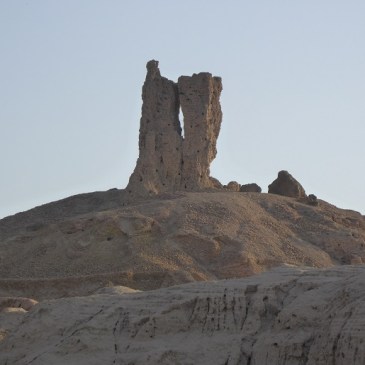
Borsippa or Birs Nimrud, Iraq
May 31, 2023
I had read of the ruins of ancient Borsippa, a sister city of the more famous Babylon. It is close to the town of Al Hillah and of course was eager to go there. Abu Mustafa, the taxi driver who had helped me find a hotel in Hillah was going to take me there and we set off in the evening.
Sun-baked plains lie in all directions with small hamlets lying along the palm-fringed horizon. From afar I see a large mound. This is thought to be a Sumerian palace. But answer must lie in obscurity because atop the mound is a mosque associated with prophet Abraham, popular among the locals. Close to it lies the next great mound once a ziggurat, its four corners aligned with the cardinal points of the compass. Its immediate boundary is fenced and padlocked and there is an outer fence too as well. On asking the driver of a passing car if we could enter, the driver of the car who looked like an official driving in a convoy, simply got out, untwisted the bit of wire holding the gate together and pushed it open. We drove in. I lacked the vocabulary to understand the whys and wherefores and was not inclined to delve to deeply lest we be denied entry. I wanted to at least walk around the perimeter of the inner fence but Abu Mustafa who insisted on accompanying me did not want us to.


On the sun-baked area around the ruins are bits of bricks piled in the channels forced by water. The base of the ziggurat has long since molded itself into lumpy mounds with the different levels showing in the stepped structure. But via the zoom on my camera I can see individual bricks of the great tower atop. The two broken halves are held together by supports and only the birds now call it home. It must have once commanded a grand view of all the surrounds for miles around.


Once thought to be the tower of Babel, it is now regarded by experts to be the temple of Nabu, the god of scribes and son of Marduk. Extensive digs lasting twenty seasons have unearthed cuneiform tablets of legal and astronomical texts here. Dating from the third dynasty of Ur around 2000 BCE and occupied until the 9th century CE, this was a sister city of Babylon in its day. An inscription of Nabuchadnezzar II of the Neo Baylonian fame, circa 6th century BCE, tells of how he restored this temple of seven spheres, covered in rich lapiz lazuli. Just imagine: for more than four thousand years it has stood on this plain, inspiring awe. The ziggurat covered in rich blue glazed bricks that seem to be the hallmark of ancient Mesopotamia must have once been an incredible sight, visible for miles.
Abu Mustafa’s misgivings proved to be true because we had sauntered a bare fifteen minutes when shouts hailed us. Two men, from the guard station at the mosque were striding down the slope. A vociferous discussion followed and I understood none of it. All I got was I wasn’t to take photographs. Clearly we should not have entered, regardless of the what the official in the car had said or done. We were duly escorted up to the guard house, passport and Abu Mustafa’s documents photographed to be given to who knows whom. But now I saw visitors to the mosque blithely taking photos of the ziggurat. Apparently the photos were not the problem, but entry to the site was. Cordiality restored, I was invited to take photos before we drove off and duly did so with overdone fanfare.


The small hamlet we passed through the small hamlet with newly built houses and a few small shops. Traffic was non-existent but by the side of the road though I saw a camel. A camel here? And then I see the man and a donkey beside him, grazing. In the near distance I see a tent, the shape reminds me of the Bedouin tents see in Morocco. I lacked the Arabic to ask about them. Ha! I thought. You can take a man out of the desert but not the desert out of the man.
 ITCHY FEET TRAVELS