Beirut, Lebanon
Aug 6, 2023
The story Walk Through the Ages would hardly be complete without some of the treasures unearthed from the site but I had to wait until I got back to Beirut to go to the National Museum. Strictly for history buffs who crave the whole picture, here it is:
5th – 4th Millenium BCE, the area marked Pre-history are pottery, funeral jars with skeletons, beaded necklaces and fishing hooks from the Early Bronze Age.


3rd-2nd Millenium BCE shows a greater finesse in models of boats, some of them quite detailed. It also shows the terracotta carts. Again, I marvel at the same items modeled across other contemporary civilizations across the globe, be it the Indus Valley or Minoan or Sumerian. I connect the dots mentally and smile at the thought.


The 3rd millenium BCE has a plethora of animal figurines, realistically carved. It also has some strnge human figures but the signage only says the grotesques and my imaginations ruts riot trying to imagine their use.


In the necropolis of 2nd millenium BCE was a literal treasure trove! Jewelry, vases, ornaments were among the hoard that the grave robbers of old missed. An obsidian mirror and a beautiful scepter with intricately wrought details as just the last ones of this treasure trove.


But even these pale in comparison to the finds from the Temple of the Obelisks. I had read about the hundreds of human and animal figurines found here and there they were – the gold plated bronze figures.


The strong influence of Egypt shows in the multiple busts and figures of Goddess Hathor, in the stylized figures, in the cat figures and in the sphinx. There are beautifully wrought axes, both blades and handles.


The advent of the Iron Age brings with it the connection with the Hittites . The cuneiform script brought by Assyrian traders shows in the tablet with a royal proclamation. The Ankara museum had a lot more of tablets but the connection can hardly be in question. And I see a lamp with the name of Goddess Tanit in Phoenician inscription. This is the same goddess from the Topet that I saw in Carthage, Tunisia. No surprise certainly, but I feel the tightening strings of the connections. This is so much fun!


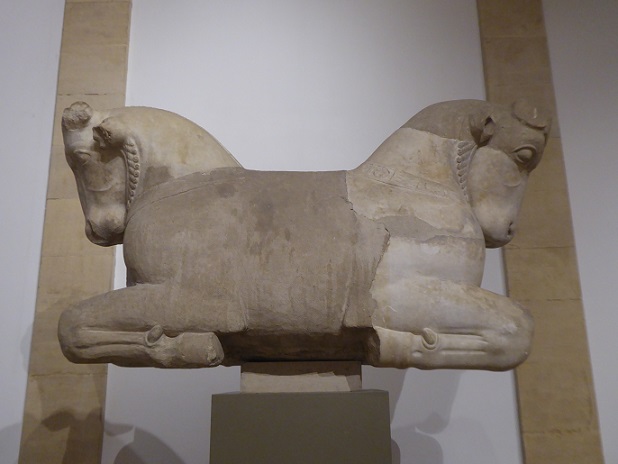
The connection only grows stronger as I recognize the exact same double-headed horse figure that I saw in Iran in Persepolis. A sure sign of the Achaemenid Empire that ruled here next.
I saw no explicit ruins from the Greek Age but here in the museum I see it. It is in the vases and the cups with their distinctive black glaze that one sees even now in Greece. The signage says it is evident of trade.


The Roman Age starting in 64 BCE has likely the largest share of statues, mosaics, and scarcophagi. This is when glass manufacture came to be. Vases, jars and bottles run the spectrum in colors and designs.


 ITCHY FEET TRAVELS
Wow some stunning pieces here! I loved the blue vase, it’s beautiful!
LikeLiked by 1 person
Isn’t it beautiful? The details on the scepter is my personal favorite.
LikeLiked by 1 person