Vienna, Austria
June 20, 2025
There are many castles, palaces and mansions that dot the cityscape of Vienna. Some are large, some small, some elegantly minimalistic and some over-the-top baroque.


Among the largest is the sprawling Hofburg Palace. It is difficult to take in the scale of the grounds, so vast is it.


But vaster still is the Schonbrunn Palace. The transition from a hunting lodge to a huge palace with sprawling grounds, was achieved largely during the reign of Maria Theresa, the only Empress of the Habsburg dynasty.


Barely prepared for the role at age twenty-three, she was enthroned queen in 1740 after her father’s death. And was instantly embroiled in the political intrigues of the times. Her memoir contains the haunting admission “I found myself without money, without credit, without army, without experience and knowledge of my own and finally, also without any counsel”.
Not only did she prevail, she reigned for forty years. As Empress of Austria and later, the Queen of Hungary as well, she did much to mark Austria’s position among the powers that be. Much is made of the love match between Maria Theresa and her husband, Franz Joseph and despite his wandering ways, they had sixteen children. Maria Theresa proved adept at cementing alliances by arranging marriages of her children with most of the royal houses in Europe. There is ample reason to call her the mother-in-law of Europe!


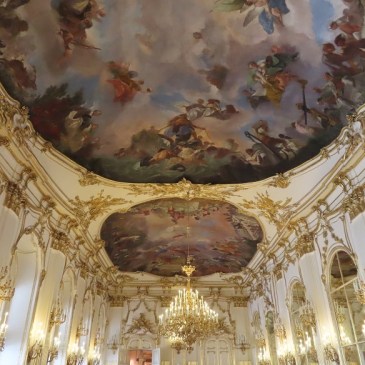
The State apartments are a brief glimpse into the tastes of this complex, interesting woman. The opulent receiving rooms have ceiling frescoes that proclaim the might of the Austro-Hungarian empire. They have hosted many illustrious personages over the years to the present day.


But she decorated the smaller rooms to the side with Asian art, particularly Chinese lacquerware that she is known to have admired.


It is a rare glimpse into the mind of an Empress and likely played an important role in shaping cultural interactions between East and West during her reign.
 ITCHY FEET TRAVELS