Mosul, Iraq
June 20, 2023
Having slowly made my way north, it is no surprise that I wanted to see the sites of the Assyrian empire – at least the ones not destroyed by ISIS. Nimrud I had read was flattened as were large parts of Nineveh. Ashur and Hatra (of the later age of Parthians) were remote enough to be spared. I showed up at the ministry for the requisite permit, but here I hit a snag. The powers-that-be have decided the only way to see these sites is to be part of a tour, complete with a guide which of course incur hefty fees. I am severely allergic to guided tours and cannot imagine being forced to trot from place to place on a tightly timed schedule, take photos at approved times with points of interest pre-determined. Were it for security concerns, I would understand but this was purely business – take it or leave it. Gone was the graciousness I had found in southern Iraq . I was simply going to climb over the old earthen walls encircling Nineveh and explore that. This was bang in the middle of Mosul so could hardly be a problem.
Although pottery has been found at this site from the Ubaid times (6000 BCE) and the son of Sargon I built a temple to Ishtar here (2335 BCE), it was during the Neo-Assyrian empire that Nineveh rose to fame and glory. Sennacherib, son of Sargon II made it a magnificent city in 700 BCE, after abandoning the capital of Dar Sharrukin. For half a century this was the largest city of the world at the time. It is no wonder – the city walls have a circumference of twelve kms and are studded with eleven gates. Today, the modern city of Mosul sits squarely atop half of the ancient site to the south of the Khosr river and the northern part is encircled by Mosul itself.


I walked to the Ahad Gate intending to work my way down the walls to the Palace complex of Sennacherib and Ashurbanipal. The gate is under restoration, having been largely demolished by ISIS but there didn’t seem to be anyone about, nor any fences or posted signs. As I approached, a man in car going the other way stopped and asked where I was headed. I explained that I was going to explore Nineveh. Imagine my surprise when he told me he was an archeologist, working on reconstruction of the Ahad Gate with an Italian team. He invited me into the trailer where I saw the map of the site, photos of the gate before destruction and plans of reconstruction. How lucky can I get? Suddenly, the day that had started out with disappointment, exploded with excitement.


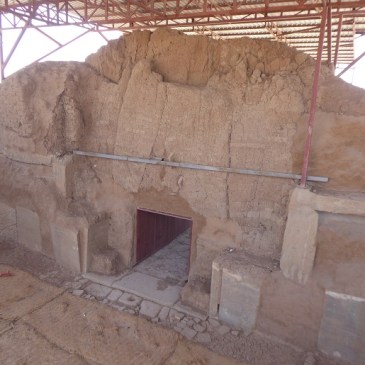
He beckoned me out and led me up the nearest mound and over the barbed wire to the excavation site under the shelter. Reconstruction has turned into excavation as they found new things, including a skeleton. I saw the original arched roof of the gate with inscribed bricks. In cuneiform, it extolled the glorious Sennacherib who had founded the city. It seemed to have been the prevailing fashion of the times – no modest heroes, these.


Peering down I saw a large hall with great stone slabs, each with similar inscriptions glorifying the king. I saw the portals and gate still awaiting detailed study. It was Mohammed who pointed out the mounds in the near distance where this Iraqi-Italian team recently uncovered a tomb. I peppered him with questions that he answered with an amused tolerance. Mohammaed was probably giving up his lunch hour to shepherd me around. I felt badly about it but he brushed it off, saying he was glad to show the history of his hometown to someone who was keenly interested.


Wearing a broad grin, I clambered up and down mounds, teetered along walls and peered over pits, listening to authentic explanations. It made my day! Really, how lucky can I get? It was the same feeling of unexpected delight that I remember from Tajikistan where I had run into another archeologist .


And it was Mohammed who drove me to the site of the palace complex of Sennacherib and Ashurbanipal. We walked up the high earthen wall to the gatehouse, expecting to explain to the guards that I wanted to see and take some photos. But the long arm of bureaucracy reaches far. The pair of guards were under orders not to let anyone in without a tour guide. I was not even to take photos from outside the fence.
 ITCHY FEET TRAVELS