
Baalbek, Lebanon
July 28,2023
The Bequaa valley is entirely controlled by Hezbollah and this is where Baalbek is located. I had met a trio of other travelers in Beirut and we set out to make a day trip to Baalbek. The road up from the coast is the usual traffic-snarled road anywhere in Lebanon with the minivan drivers racing each other in their usual fashion. But the scenery is beautiful as we climb.


Although now famous for the UNESCO World Heritage site of its Roman temples, Baalbek was a place of worship even before the roman era. The name of the city itself comes from Baal, the Phoenician god of storm and Bek, which is city. Hence the City of Baal or Baalbek.
After Alexander the Great’s death in 323 BC, when his empire was divided between his generals, it was Ptolemy who took Egypt as his share and added to it, Phoenicia and Syria. It was during this Hellenistic period (333-64 BCE) that the Baal was identified with Ra, the Egyptian Sun god and this city was known as Heliopolis, or City of the Sun. The courtyard of the old temple was enlarged. Further modifications came with the Roman period and building of the triad of temples on a grand scale. These are what we come to gawk at.
Temple of Jupiter
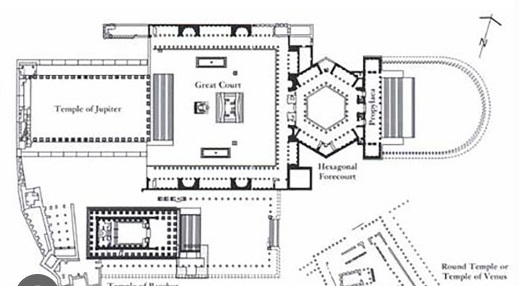
Up the steps, the long forecourt still has some standing columns. Beyond is the hexagonal courtyard, a rarity in typical roman architecture.


Further on is the great courtyard. Some walls of this vast area remain, with intricately sculpted niches but most of it lies in as giant blocks tumbled around the area.


Beyond is where the Temple of Jupiter once stood. Nothing remains except for a few columns. Built on a massive scale, this is even larger than the Parthenon in Athens although not in nearly as good a shape. The sheer scale is stupefying even in this broken state. Some of the outer walls remain, made of gigantic blocks of stone. A few gaps in the wall frame the fields in the distance.


Temple of Bacchus
From the platform of the Temple of Jupiter, we see the Temple of Bacchus down below and troop down to it. On the ground lie pieces of the roof, pillars and walls. The boys are like putting their heads in the lion’s mouth. Literally.


This is better preserved and awe-inspiring, both for the scale and the detail. I can just imagine what it must once have been like. There is graffiti on the walls bearing dates from 1880s. Who says graffiti is new?


Temple of Venus
Just outside the fenced area is the smaller temple of Venus, hemmed in on all sides by the road and the town itself.


 ITCHY FEET TRAVELS