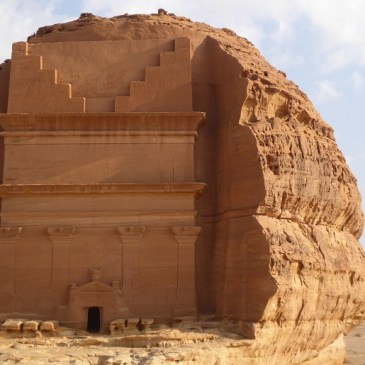
Madain Saleh, Saudi Arabia
Dec 29, 2023
While Petra is well known the world over, lesser known is Al Hijra in Saudi Arabia. Called Hegra or Madain Saleh locally, this was a second city built by the Nabataeans between 1st century BCE and 2nd century CE. Its induction as a UNESCO heritage site is as recent as 2008 and yet more recent is the access for a tourist. Having gawked at Petra, I wanted to see this – one of my primary reasons for visiting Saudi Arabia.
The site itself is much smaller than Petra and walkable but I found to my dismay that we had to be ferried to the site. And there was worse to come. Buying a ticket at the entrance, I was told that access was only in the form of a guided tour lasting 2 hours with set timings. I had the choice of 1 pm or 2 pm or 3 pm. Unlike Petra, where one is allowed to wander at one’s own pace and can even buy a multi-day ticket for extended visits, this was a strict two hour trip to just four of the hundred monuments, complete with a guide jabbering in your ear the entire time. The more exalted rode in jeeps or golf carts while I was bundled into a bus of about thirty people.
Disgruntled to begin with, this proved to be a race of leaping out of the bus, trying to get to each monument before it was inundated with tourists intent on selfies. And then being bundled off into the bus again to repeat the entire process at the next stop, the time at each stop barely twenty minutes.


Although touted as a city with buildings and wells, all we were allowed to see were tombs. Each is carved out of a rocky outcrop, some just large enough for a couple of tombs and some where the entire ridge is riddled with multiple tombs. The late afternoon sun poured down and the rockfaces glowed as if lit from within. It was a stunning sight albeit not quite at par with Petra.


The first stop on the bootcamp tour was Jabal Al Ahmar, a loaf shaped rock with a few finished tombs with elaborate doorways. All are identical in design, with a steplike pattern above the doorway tapering down to an eagle with widespread wings atop the portal. The entire rock is carved out like a honeycomb with plenty of openings showing chambers within. Some are large, some small but all are empty.


Second is likely the most photographed tomb in Hegra, called Qasr Al Farid. The dome of the rock had been sliced vertically almost in half, with the entrance carved on the flat face. Although it is the largest façade in Hegra, this tomb was never finished.


The third stop was the long ridge of Jabal Al Banat. Called Qasr Al Bint, this was the largest we saw. It is riddled with tombs. Not only are there tombs carved on all sides, some are carved at two levels. But the patterns are identical; the same steplike design on the portal, the same eagle carved atop the doorway.


The last one was one large space hollowed out of the rock, presumably a meeting place. There are a few niches carved on the rock face at eye level, mostly obliterated so the motifs are indistinct. There are a few lines of what looks like script but indecipherable.


The narrow space between the adjacent rocks make for a chasm-like look, reminiscent of Petra. But there the similarity ends. What we were allowed to see in this whirlwind tour were neither as elaborate, nor nearly as grand. Underwhelmed, I trundled back in the bus and valiantly resisted the attempt to steer me to the handicraft shop with its overpriced products.
 ITCHY FEET TRAVELS