Krakow, Poland
July 29, 2025
The year is 1941. Poland has been under German occupation for two years and Krakow has been turned into the capital of the General Government. Persecution of Jewish residents have reached the level where they are now treated as vermin. About 40,000 have already been expelled from Krakow and the remaining 15,000 are forced to move to a nearby area of Podgorze.


They are crammed into an area previously occupied by 3000 and a wall designed like tombstones is built around the area. The four gates are strictly controlled and entry regulated. The Jews aren’t allowed out.


Life is unimaginable within the ghetto. Their own words paint a better picture than I possibly could.


A year passes and from end of May 1942, the Nazis carry out systematic deportations from the ghettos to the surrounding death camps. June 1942 sees over 7,000 from this ghetto taken to the Belzec extermination camp. On 13th and 14th March 1943, the final liquidation of this ghetto is underway. About 2000 are deemed fit to work and are sent to Plaszow labor camp. The remainder, some 2000 are murdered on the streets or sent to Auschwitz-Birkenau to be exterminated. It is these days of horror that are said to have made Oskar Schindler determined to save his Jewish factory workers.


Schindler had been in Krakow since 1939, having come on the heels of the Germans. He had applied to and been accepted as a member of the Nazi Party. Through a mix of bribery, bluff and corrupting officials, he made a network of German contacts and had been exploiting the black markets. It was through these contacts that he was able to secure the lease of a formerly Jewish-owned enamel factory, Emalia. In the beginning among a staff of several hundred only seven were Jewish. By 1942, about half his workers were Jewish. Schindler had convinced his superiors that his workers were cheap labor and he paid their salaries to the SS. Rumors floated about Schindler; in the words of one woman:
There is one factory where Jews are barracked, legends are circulated about it. The factory is called Emalienfabrik, while its director is some strange high-ranking German named Oskar Schindler. They say that the Jews in that factory are not beaten and they get decent food. Everyone tried to get a job there but only a few hundreds can be employed. Schindler is said to have promised to save the lives of the people barracked at his factory. No one knows how he is going to do that. – Stella Muller-Madej
In the words of another:
For us, “his Jews” Oskar Schindler became a kind of father… He had not arrived in Krakow as a heroic saviour but as a regular entrepreneur…But with the years we changed in his eyes from cheap workforce to human beings whom he decoded to help.Many of us even became friends with him. – Mistek Pemper
When the Paszcow labor camp opened under the notoriously sadistic officer Amon Goth, Schindler capitalized on Goth’s appetite for drink and luxury items only available on the black market. By bribing him with such items, he prevailed on Goth to make a separate camp for his Jewish workers. In August 1944 when the factory was decommissioned, Schindler successfully petitioned to have it moved to Brunnlitz, closer to his hometown. And then made a list of Jewish workers he deemed essential, a list of 700 men and 300 women. Another 100 were from a concentration camp were added to the list.
The factory building is now a museum with Schindler’s story, a section in the larger story of Poland from 1918. A large glass case filled with enamelware has an opening and inside on a circular wall are the names on the list.


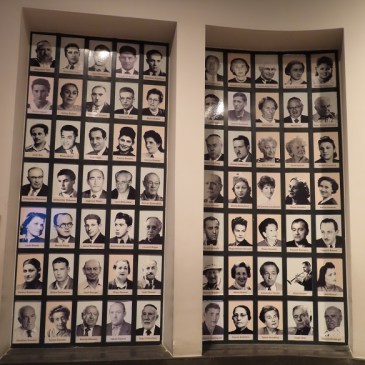
Faces from the list smile out from photos on a wall downstairs.


A photo of some of the survivors at his grave and a poignant remark made by one of them seems a fitting end to the story of a man named Schindler.


 ITCHY FEET TRAVELS