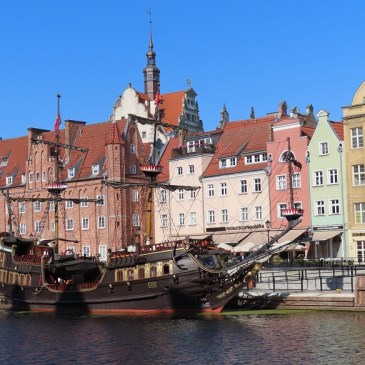
Gdansk, Poland
July 22, 2025
Situated at the mouth of the Motlawa river, 14th century Danzig was a major port on the Baltic Sea, especially for grain. As a leading member of the Hanseatic League, Gdansk, as it is now called, saw immense amounts of grain flowing through it. This necessitated granaries; in fact so many that they took up an entire little island on the east bank of the river – the Granary Island. This little island has seen floods in the 16th century, fire in the 19th century and was almost completely destroyed in WWII bombing. Only recently has it been reborn as a locale for tourism. The old granaries are re-built in the same shape but mostly re-purposed as hotels, cafes, restaurants and shops. What is strange is that new buildings that are going up are built in the same form. The tourism industry has found a winning card and will keep playing it.


A short walk west across the bridge is the Old Town of Gdansk, also rebuilt, a process that continues today. The row of houses are broken by huge gates allowing entry into the heart of the old town. The Green Gate still is a through-street going all the way through the old town. St. Mary’s Gate leads to the church of St. Mary. There is also the Holy Spirit Gate and the Chlebnicka Gate, all leading into cobble-stoned streets of the old town.


A couple of towers stood guard, one at the south end of the Granary Island called Stagwie Mleczne and one at the north end of the old town. The north tower was called the Fish Market Tower in the 15th century, which makes sense to me, but then the name then changed to Swan Tower. There must be a story to it, but none that I can unearth. Another couple of towers were built to support a massive wooden crane, originally built in 1367. Built to handle heavy loads, the two cranes combined could lift 4 tonnes up to 11 meters; quite an engineering feat!


Wandering the cobble-stoned streets, I find a few remnants of the old wall then run smack into St. Mary’s church. It is mammoth! I can readily believe it is the largest in Europe; it sprawls over multiple blocks and rears up so high that it is impossible to get a decent view from ground level.


At the western edge of the labyrinth of streets is the forecourt. A pretty building with a lovely roofline turns out to be the Prison Tower, now posing as the Museum of Torture. Adjacent to it is the Forecourt, now a souvenir shop.


Dluga Street, known as the Long lane runs from the Green Gate all the way to the Prison Tower and in the middle is the lofty Town Hall. The carillons chime in the belfry and the Neptune Fountain in front tinkles in the sunshine as crowds pose for selfies.
 ITCHY FEET TRAVELS