Baalbek, Lebanon
July 28,2023
The Bequaa valley is entirely controlled by Hezbollah and this is where Baalbek is located. I had met a trio of other travelers in Beirut and we set out to make a day trip to Baalbek. The road up from the coast is the usual traffic-snarled road anywhere in Lebanon with the minivan drivers racing each other in their usual fashion. But the scenery is beautiful as we climb.


Although now famous for the UNESCO World Heritage site of its Roman temples, Baalbek was a place of worship even before the roman era. The name of the city itself comes from Baal, the Phoenician god of storm and Bek, which is city. Hence the City of Baal or Baalbek.
After Alexander the Great’s death in 323 BC, when his empire was divided between his generals, it was Ptolemy who took Egypt as his share and added to it, Phoenicia and Syria. It was during this Hellenistic period (333-64 BCE) that the Baal was identified with Ra, the Egyptian Sun god and this city was known as Heliopolis, or City of the Sun. The courtyard of the old temple was enlarged. Further modifications came with the Roman period and building of the triad of temples on a grand scale. These are what we come to gawk at.
Temple of Jupiter
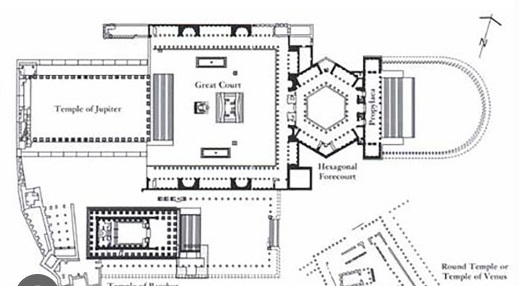
Up the steps, the long forecourt still has some standing columns. Beyond is the hexagonal courtyard, a rarity in typical roman architecture.


Further on is the great courtyard. Some walls of this vast area remain, with intricately sculpted niches but most of it lies in as giant blocks tumbled around the area.


Beyond is where the Temple of Jupiter once stood. Nothing remains except for a few columns. Built on a massive scale, this is even larger than the Parthenon in Athens although not in nearly as good a shape. The sheer scale is stupefying even in this broken state. Some of the outer walls remain, made of gigantic blocks of stone. A few gaps in the wall frame the fields in the distance.


Temple of Bacchus
From the platform of the Temple of Jupiter, we see the Temple of Bacchus down below and troop down to it. On the ground lie pieces of the roof, pillars and walls. The boys are like putting their heads in the lion’s mouth. Literally.


This is better preserved and awe-inspiring, both for the scale and the detail. I can just imagine what it must once have been like. There is graffiti on the walls bearing dates from 1880s. Who says graffiti is new?


Temple of Venus
Just outside the fenced area is the smaller temple of Venus, hemmed in on all sides by the road and the town itself.


 ITCHY FEET TRAVELS
Truly an impressive place! Does the presence of Hezbollah make it safe?
LikeLike
Quite the contrary. This is an armed and militant group modeled after Iran’s Khomeini party. Many of the governments – US, UK, Germany, the Arab League, Israel are among a growing number of countries that consider them a terrorist group.
LikeLike
Oh I know that they are the ‘baddies’ but what I meant was if they make it safe for travellers to go there? Do they leave tourists alone or can it get dangerous for the average traveller? Sorry i should have structured my sentence better.
LikeLike
Lol re “baddies”. 😉
I did not stay in the town or explore it but just visited the ruins as a daytrip from Beirut. The ruins themselves are perfectly safe I think. Anything untoward happening to tourists would be like killing the golden goose, right? It is much-needed revenue in the currently dire economic straits of Lebanon. Does that help answer your question?
LikeLike
Yep makes sense! I thought that Hezbollah might leave tourists alone because of the $$$ factor. Thanks for answering! X
LikeLiked by 1 person
Money talks – loud and clear apparently. 😉
LikeLiked by 1 person
The Temple of Jupiter and the Temple of Bacchus in Baalbek were my first ever Roman ruins, and my best friend who traveled with me to Lebanon told me to lower my expectations when I go to other Roman ruins afterward. Being amazed is an understatement. When I went in 2019, those remaining pillars of the Temple of Jupiter were still covered in scaffolding for restoration.
LikeLike
This is great! We can compare notes, having seen the same places over roughly the same period in time. But I have to differ re lowering your expectations re Roman ruins.
Of the ones I have seen so far, methinks the temples themselves are more complete in Baalbek but the ruins at Gerash in Jordan are superior in extent and completeness. And then there is Ephesus in Turkey which is small but spectacular! Carthage in Tunisia has extensive ruins as well – complete enough to be used to this day. And I assume you are excluding ruins in Italy itself?
LikeLiked by 1 person
Six months after I went to Baalbek, I visited Jerash and I must say I was impressed nonetheless. Both are different. While I was astonished by the sheer scale of the Temple of Bacchus, Jerash’s colonnaded streets truly were a sight to behold.
LikeLiked by 1 person
Totally agree. I found Jerash more spellbinding, especially the circular area with all the columns.
LikeLiked by 1 person