Byblos, Lebanon
July 30, 2023
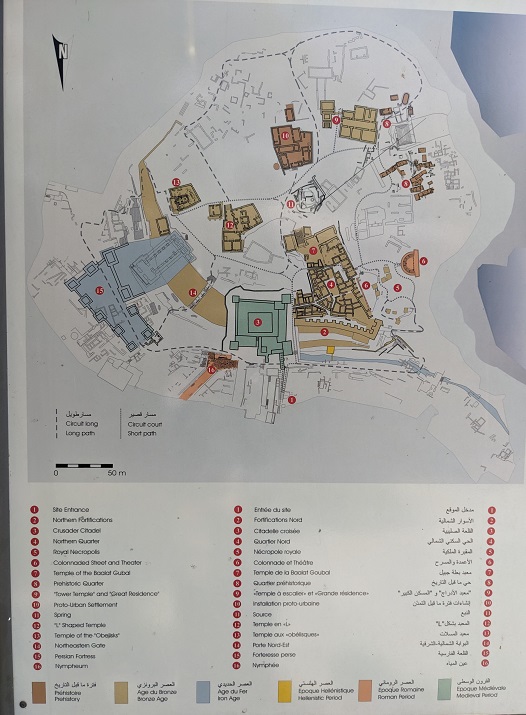
The promontory of Byblos has seen the march of human evolution in this area almost continuously since the earliest settlements. Each successive era has left behind their own mark and walking through the site is like walking through the pages of a history book. If these stones could speak, what a tale they could tell! I am literally treading the path of all those who came before. The very thought has me grinning.
5th – 4th Millenium BCE
Like other places in the Fertile Crescent this has been home to Neolithic communities from 5000 BCE. They lived here in monocellular houses with pebbled beds plastered with crushed limestone. A thousand years later, this area is still inhabited but the houses have evolved into rectangular structures with earthen floors, equipped with hearths and silos. Funerary jars found onsite have yielded fishing hooks, ceramics and jewelry. There are remains of stone walls showing small enclosures and narrow pathways. They face the sea with a view much like I see now, bar the sprawl of concrete.


3rd Millenium BCE
A residential area dated 2900-2700 BCE is amazingly well-preserved. From the top of the citadel of a much later age, I have a birds’ eye-view of the well-planned streets and enclosures. This is proto-urbanization of Early Bronze age. I saw startingly similar structures in Sarazm in Tajikistan in Shengavit in Armenia and more recently of the Sumerians in Iraq . Perhaps it is not so startling; rather it points toward migration from one to another or at least communication between these peoples across these areas. I am still on the trail of human civilization as it branches out.


The Bronze age sees numerous temples built around a spring or perhaps a sacred lake. The spring has been used over the ages, with walls and sloping pathway added to over the ages. The L-shaped Temple, so called because of its shape was built in 3rd millenium BCE but no clues are left to identify the deity since it was destroyed in a fire in 2300-2100 BCE.


3rd – 2nd Millenium BCE
A massive structure on the edge of the coast is called the Tower Temple, built between the 3rd and 2nd millenium BCE. Thought to belong to the elite, it boasts an enormous foundation tapering upward. No signage gives any indication of its history and the ruin itself was taped off unfortunately, but I had a slightly better view from further up the path.


2nd Millenium BCE
Temple of obelisks is built on the ruins of earlier L shaped temple dedicated to the god of war Reshef. Gold and bronze weapons and human and animal figurines were found here. Of the actual temple, nothing remains but the courtyard filled with obelisks. It is in this era that present day Lebanon was a part of the Hittite Kingdom and this is when the Kadesh Treaty with Egyptian empire was made. I remember the cuneiform tablets and letters from the museum in Ankara and I saw the remains of their mountain stronghold just recently in Hattusa . Here is the later link in this summer’s journey. A little hop and a skip punctuates the thought as I walk on.


It is also in this era that references are found to Phoenicians. Not a kingdom but more a collection of city-states, they were well known as seafarers, carpenters and boat builders.
The continuing Egyptian influence is no doubt responsible for the elaborate burial chambers found here. And that too accidentally. A landslide in the area exposed the royal necropolis in shafts dug deeply into the cliffs. All but a few had been the victims of grave robbers of ancient times but the empty holes and shafts remains. Steps lead down into yet more tombs honeycombing through the cliff.


1st Millenium BCE
It is the Age of the Neo Assyrians and Phoenicia is included within their empire. None of the structures here are attributed to Assyrians per se but perhaps some artifacts lie in museums.
It is also now that the Phoenicinas have established colonies and trade posts up and down the Maghreb, as far as Carthage. The Phoenicians had a reputation for cunning and I remember the tale of Dido and the founding of Carthage .
7th-5th Century BCE
The Iron Age heralds the glory days of the Persian Empire as it extends over a vast swathe from Mediterranean in the west to the Indus river in the east. Byblos is included in the Persian legacy as a fortress added onto over time. Little remains but I see a tell-tale lion image in one wall of the fortress.


4th Century BCE
Alexander the Great marches through here on his conquest of the world and Byblos too is part of this vast empire. It remains a Seleucid empire after Alexander but strangely I see nothing of this era. There are many areas still that are either unexcavated or unsigned so who knows? There may be more yet.
64 BCE
A part of the Roman Empire, Byblos too boasts its own amphitheater and colonnaded avenue. The amphitheater is almost intact and I dare say can host a concert or play. With a backdrop of the blue ocean, who can resist? Around the corner is a Temple of the Nymphs, barely recognizable.


12th Century CE
The Crusader castle that most come here to see is only the latest in a long line of buildings left behind from ages past. It towers over the site affording a grand view of the surroundings. Built in 1140 CE, it is a definite newbie in this place whose memory runs far into the distant past.


When I was in Jordan 4 years ago some of my tour mates were going on to Lebanon and I so wished I had the time to join them! After my first foray into this region with Jordan I fell in love and would love to explore more!
LikeLike
Do go see!! There is plenty to see but off the radar for most. For me personally, the less the traveled places hold a special charm. But I bet you knew that already! 😉
LikeLiked by 1 person