
Taitung, Taiwan
Aug 10, 2026
Close to the northern edge of Taitung there is an extensive area that was once home to the Peinan tribe. Although the local Puyuma indigenous population call themselves Peinan or Beinan, some anthropologists believe that it is the Paiwan who were the original inhabitants of this site, based on the use of slate which is their hallmark. Others think the Peinan moved to the coast and over the millennia became the Amis. The theories are hotly debated but whatever the truth, it is here that we see remnants of a Neolithic culture that flourished around 2000 BCE.
It is this and likely the contemporary Chilin culture on the coast that gave rise to the Austronesian speaking peoples who spread out to populate island South East Asia and beyond. Of the two sites, this is the most complete and still undergoing excavation.
I arrive agog with curiosity and peer over the railing. It looks like a jumble of stones but there is a map that shows a carefully planned community.
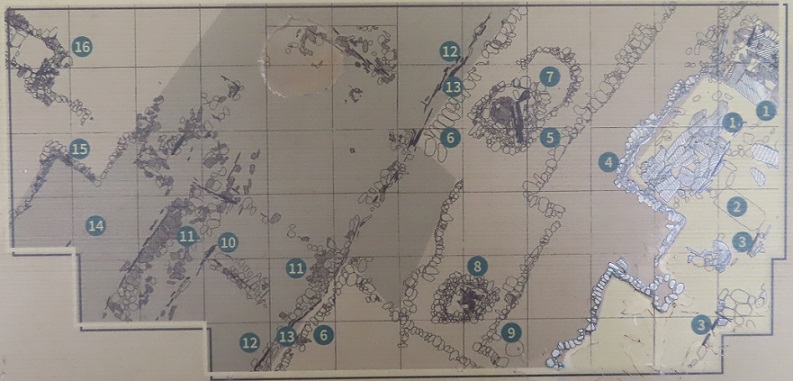
The signage is good and I can see the village take shape in front of my eyes. I see stacked stone walls with clearly marked passages between them. I see the walls of dwellings, carefully laid slate floors and round storage structures. A rounded hollowed stone is presumed to be a mortar.


In common with all Neolithic cultures, there is ample evidence of stone use. Some of the finds are in the Exhibition Hall on site. I see axes, arrowheads, carved out lengths that look like stairs or perhaps animal troughs. There are even stone needles thought to be used to pierce hide for clothing. Most curious of all to my mind is a round stone with a hole in its center. Although we would instantly recognize it as a wheel, curiously, these peoples hadn’t discovered a wheel or its use until their contact with other nations.


There are pottery sherds half buried in one corner but the best of them are on display at the Taiwan Museum of Prehistory in Kangle where I happily spent most of a day.


An important discovery at this site are the sixteen hundred slate coffins found so far. Most are individual coffins, the size customized to the individual. But there are a few that were used for multiple individuals. They all lie in neat rows, oriented so the feet of the deceased are toward the Dulan mountain on the coast. Why so? In the absence of any written language, experts can only offer conjectures.


Perhaps the most important discovery are the plethora of finely fashioned jade ornaments and spearheads that were placed as grave goods. Circular earrings, hollow tubes and a necklace made of tiny bell shaped pieces of jade are all housed in the Preshistory museum. The most famed of all is a zoomorphic pendant exquisitely carved, showing two human figures with an animal atop their heads. I see one that to me looks like a boat with multiple rowers. Does this mean they were seagoing? Questions bubble up in my head, but the attendant does not know. It is from here that the jade trade spread to the rest of the world with the migrations of these peoples. There are also spearheads of Nephrite, attesting to fine craftsmanship all those moons ago.


Some way distant from the site, standing today on a green expanse are tall slate pillars. They are flat, upright and all are oriented in the same direction. The megaliths have one or two holes toward the top, thought by some experts to have been used to anchor wooden beams. Others debate they were used to mark sacred spaces. The answer is lost in the mists of time. But they are eerily reminiscent of the uprights I saw in Armenia, except these are much flatter.


The current theory although the dates are debated, is that around 1500 BCE this site was abandoned and the peoples had moved to the coast. From there they and other coastal tribes set sail on uncharted waters in their outrigger canoes. Archeological evidence of Peinan jade found across southeast Asian islands provides incontrovertible proof of their journeys. Similarities in language and genetic evidence too point to these peoples spreading to populate far flung islands. I am on track in my self-imposed project of tracing the Austronesian migration. Yes! I dance a little jig, looking forward to the next step.

