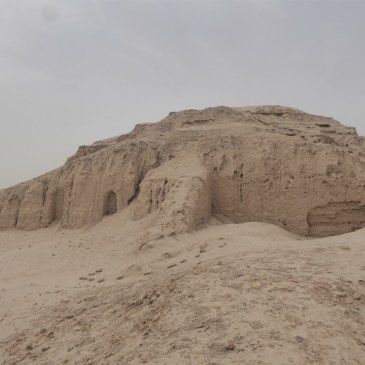
I usually write these tales in chronological order of travel but this story is presented a little differently. The sites I saw are more fittingly presented as came to prominence in history.
Apart from the much-visited sites of Ur and Babylon, it is not easy to visit others. I had to request permission from the department of antiquities which was graciously granted. But arranging transport is not simple, nor is it inexpensive. It reminded me of similar jaunts in Tajikistan born of equally hare-brained ideas. I had a long list of sites I wanted to see in Iraq but did not quite manage them all. The archeological sites in Iraq are densely packed. Much like looking at the map of sites in Pakistan and longing to see them, I promise myself, I will return.

The Tale of Mesopotamia
Once upon a time, some ten thousand years ago, the humans in the fertile crescent (present day Iraq, Syria and Turkey) changed their mode of life from hunter-gatherer to a settled one in foothills of the Zagros mountains (present day Kurdistan). Archeological evidence area shows they domesticated plants and animals and used tools. Fast forward a couple of thousand years and we find them living in mud-brick houses in areas near present-day Mosul and Samarra, making pottery with intricate patterns and worshipping a mother goddess. The exhibits in the Iraqi museum in Baghdad, among many others provide a mute testament.


There is no single theory that experts agree on as to why these peoples moved from the foothills to the plains. But from 6500 BCE they diffused throughout lower Mesopotamia, and habitations mushroomed along the banks of the Tigris and Euphrates. Small hamlets changed to villages and villages to sizable towns. The very first city as we know it, was Eridu, circa 5400 BCE, in the far south of Iraq. Much as I wanted to, I could not go to the site. 4000-3000 BCE sees Mesopotamian cities dotting this plain in their glory.
URUK
Samawah, Iraq
June 5, 2023
This is one of those sites off the beaten path, unfrequented by most tourists and travelers alike. I would never have managed to get here either, were it not for the kindness of strangers
It is late morning when we arrive at the gates of the small guard house. A fence stretches out in either direction as far as the eye can see. A couple of peeling signboards announce the guard house and pronounce welcome. There are no habitations in the vicinity and the power lines march off into the distance. A haze of dust obscures anything beyond the middle distance.


I am greeted with a ‘welcome to Iraq’ and go through the usual process of registering the passport, paying the fee of 25,000 IQD as in other sites. On the short drive to the guard post inside, I see the edge of the ziggurat of Anu. As is usual at these sites, a police guard accompanies me at all times. Unlike the one at Kish, here the guard seems genuinely happy to share the history of this place. Ahmad, the taxi driver tags along.

I can barely contain my delight. Here is the first large city in the world, begun sometime in the 4th millennium BCE. The origin of the massive ziggurats of Anu and Inanna, supreme god and goddess of Sumer, the Stone Cone temple and the Limestone temple all have their beginnings in this period.
The old railroad tracks used by the German excavation team still lie on the site. All around are various mounds and not another soul in sight except for us. The ground is littered with sherds of pottery as we head toward the ziggurat of Inanna. I gaze in awe at the remains and imagine the structure at its height. I imagine the façade of the temple as it once was, with its carved male and female figures, seen at the museum in Baghdad. The wind feels like it is out of blast furnace. It whips at us whispering tales of long ago.


This is where writing came to be, first as pictorial proto-cuneiform which later evolved into cuneiform as we know it now. A sign proudly proclaims the fact and there! At the foot of the ziggurat is a slab with faint markings. There are some stone cones piled on top, from the pillars and walls that had brilliant mosaics made of these cones embedded in plaster walls. Most are housed in museums around the world now.


We are guided around the corner to the adjacent face of the temple. I see a large area, maybe a platform leading to the temple made of flat bricks, some still covered with specks of bitumen. There are vertical brick walls in this face too, believed to be channels for libations, of what we know not. The guard smiles at my delight and waits patiently as I go click-happy. He leads us to the base of the next corner and we peer down a well. Even in its state of decay, it is easily 3 meters deep. Near the rim I see broken bits of pots buried in the walls.


Walking past the third side of the ziggurat, we go past remains of buildings, some of the walls visible but the layout difficult to imagine. Toward the end of this side of the ziggurat is an archway still standing.


Uruk has been continuously inhabited for a couple of millenia and each age added their own signatures. We are walking over layers of history! We round the corner and head toward the next mound, the temple of Irigal. There are boards here too but any writing they once had have long since been erased by the sun and wind. We climb up and there down on the ground I see a blue-glazed brick. This is the famous indigo blue of lapiz, brought from distant Afghanistan. All that blue of Babylon must have once been covered by the same glaze.


And then I look up and gasp. There is enough of the remains to see the bones of the temple. And there! I see two of the walls with many bricks still wearing the glaze. I am slack-jawed and no doubt look stunned.


The guard is enjoying himself thoroughly by now. He walks on down a passageway and points around the corner and watches for my reaction. He is not disappointed. I see arched corridors facing a courtyard, the high walls in excellent shape. The arches have the mushroom shape that I saw in Ethiopia! There are even niches in the wall meant for lamps.


The pillars of the central structure in the largest courtyard, are still intact. Made of semicircular bricks, it is an ingenious way of making a rounded column. The guard points out a stamped brick – a practice that seems to have continued through the ages here.


Around another corner is the temple of Salouquee with a vast empty courtyard. As we peer down from the top of one wall, I see traces of the same blue again. More fodder for my imagination to run riot.


We walk down the slope and I see bits of the mosaic wall with its colored cones of stone. Embedded deep into plaster, they were designed to make a striking pattern. The columns too are now housed in a museum in Germany, a standard agreement at the time of excavations more than a hundred years ago. But a tiny bit remains.


The remnants of a white wall may have once been the Limestone temple although the guard tells me it was a swimming pool. He points to marks of palms and fingers as proof and I do not demur.
With the air of a conjuror he moves aside a stone and shows me some bone and stone tools. I am an appreciative audience and later he shows me a small head and a figurine. I can see them in a museum, but somehow seeing them in situ feels so much more rewarding.


We have been traipsing around for more than an hour. My water bottle has been empty for a while and a couple of times I feel on the verge of fainting. We go back to the guard house and drink cold water. I sit awhile and would have happily gone back to exploring more of this vast area. But Ahmad the taxi driver has been fidgeting for a good while now and so we leave.
This city remained powerful through the Early Dynastic period of 2900-2350 BCE. Many were the kings who ruled from here, each in his turn adding to the city. Gilgamesh, said to have been the king of Uruk around 2700 BCE, encircled the city with a wall more than 9 kms long. Experts estimate as many as 50,000 people then called it home.


The Epic of Gilgamesh, begun as Sumerian poems hundreds of years after his time, have been found in far flung parts of Mesopotamia. Excavations have unearthed various tablets written at various times in libraries of rulers who came after him. In common with other epics from different cultures at different times, this too reads like a fairy tale. Snippets of it run through my mind as we leave:
In Uruk,he built the walls, a great rampart, and the temple of blessed Eanna for the god of firmament Anu, and for Ishtar, the goddess of love. Look at it still today: the outer wall where the cornice runs, it shines with the brilliance of copper; the inner wall, it has no equal. Touch the threshold, it is ancient.

