KISH
Al Hillah, Iraq
June 1, 2023
This is yet another ancient site that is not visited by many and I had an uphill task trying to get there. Abu Mustafa’s son Yusuf was already disgruntled because I had spent too much time in Babylon but agreed to go with an air of resigned good humor. We set off with me navigating via google maps. The usual police guard post lay at the entrance. Duly registered, I am surprised that I do not have to pay the 25000 IQD that is the norm at all sites. The usual police guard traipsed along, a look of extreme annoyance on his face. Yusuf sat in the cool of the guard house and hoped I would be fast at this one.
To be known as the “King of Kish” was to be the holder of ultimate prestige, such was the fame of Kish. And this title was adopted by rulers of other later kingdoms of Akkad, Ur, Assyria, Larsa and Babylon, well into the 1st millennium BCE. According to the Sumerian King’s List, this was the first place where kingship descended from heaven after the historic flood with Etana, its first king. Believed to have been founded as early as 3200 BCE, it was the only major city in the northern plains while most others were clustered in the south. A place of strategic importance, Kish was coveted by all the squabbling kingdoms of Mesopotamia. The rise of Babylon in the 2nd millennium BCE signaled the decline of Kish’s importance and it receded into obscurity.
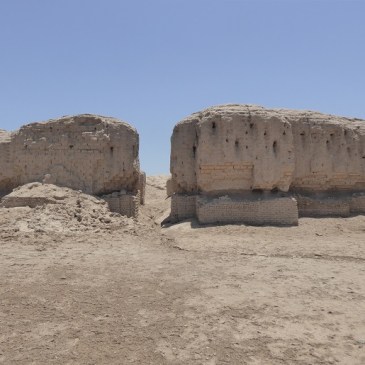
From what I had read about excavations at this site, of the forty mounds, the most important are the Tel Uhaimir with the remains of the ziggurat and temples to the west, Tel Ingharra with its two ziggurats to the east. Police guard in tow, I headed to the ziggurat of Tel Uhaimir. The baked brick walls of the ziggurat is still imposing after a passage of five thousand. The narrow opening is lined with newer bricks at the bottom of what once was the base of the ziggurat. Water channels have cut a path and we climb up.


As at other sites, the ground is full of sherds, some large, some small. All around are mounds of various sizes, all a part of this ancient city. But the guard is disinclined to let me potter and keeps miming he has to go. I wish I had the vocabulary to explain to him how long I had waited to see this and how far I had come to do so. I just tune him out and decide to take my time.


Kish is the site where elite burial sites were discovered, the dead interred with wheeled chariots. This was a precursor to later more elaborate royal burials found in Ur where entire retinues of servants and animals were buried with the royals. This is also where upward of 300 animal figurines were found. I remember the figurines from Mohenjodaro that I saw in the Museum in Karachi. Were these civilizations in contact with each other? Did they trade? I have no answers. The Sumerian section at the Iraqi Museum in Baghdad had been closed when I visited so there are no artifacts I saw that I can link to Kish either.
A little north of the wall are the remains of two temples, connected at the southwest corner. I have seen maps of the temples with their courtyards and rooms clearly delineated. But even with my imagination on overdrive it is a stretch to map those plans to what I see.


The guard is already striding back and I have no choice but to follow. I too now wear a look of annoyance on my face.
 ITCHY FEET TRAVELS