Geremiaka, Eastern Highlands,
Papua New Guinea
Sept 17, 2026
The guesthouse might leave a lot to be desired, but meeting the other travelers was an unexpected delight. A well-traveled lot, they are traveling on their own; I am in good company! Sitting around the table over a meal we exchanged hairy tales of travels amid gales of laughter. A few had made plans to visit a tribal village about twenty kilometers from Goroka and I jumped at the chance to join them.
John is from Geremiaka and is our contact. He has arranged transport, which is not easy to find here and we set off. With me are Lincoln and Charlie, a couple from Hong Kong, Leong from Malaysia and Tassos from Greece. The first thing I notice in the van is a dead rodent hanging from the rear-view mirror. I wonder if this is the PNG equivalent of foam dice.
“Is that for good luck?” I ask John.
“Oh no, it is for decoration” he replies.


The tarmacked road winds through valleys with dirt tracks going off it. Most houses are thatched huts in various states of disrepair. But there are a few new ones of concrete with tin roofs. Well-tended garden plots flash past the window. It looks uncannily like rural Angola I traveled in not long ago. Most grow their own vegetables, John tells us, sweet potato and cassava being major crops. That, combined with plentiful fruits from their trees form the bulk of their diet, occasionally supplemented by domestic pigs.


There are people waiting by the road for rides and we pass a couple of trucks heading to Goroka. The dearth of regular transport translates to packed rides on flat beds with plenty hanging off the edges. Our waves are returned with cheery greetings.
If I want to see other parts of PNG, I suppose I would have to travel in the flat beds too, I ask John. He tells us that there are some public motor vehicles (PMVs) but as foreigners he advocates caution. “Talk to the driver and the conductor” he tells us. “They will take care of you. And make sure the lodge when to expect you”. This will be more challenging than Angola I mull; maybe more like South Africa.


John shows us around when we arrive, introducing us to the villagers. Most are extended family, used to visitors now that John has been showing travelers his village for a couple of years. We meet with smiles and welcomes. And we meet Matt. From the UK, he has been living in the village for a week, having a grand time. And he’s made a special friend; a little piglet. How I would love to stay awhile in this village! I remember fondly my sojourns in a mud hut in Zambia and at a village in Swaziland (Eswatini ). I barely got here and am already thinking I’ll have to come back with more time!


The houses are on a ridge with a lovely view of the valley. I learn to my surprise the woven walls are made by experts, each specializing in different patterns and materials and hired for their labor. Between the huts are garden plots bordered by fruit trees. Most of the food grown is for their own consumption. There seems to be sufficient food in this village but little in the way of earning cash. John’s tour enterprise helps and some of the women sell handicrafts.


We are hospitably invited to look inside the huts. A peek inside one shows a child’s scattered schoolbooks. The child himself is busy poring over a phone in the next hut. There is no electricity in the village but they have solar lamps and chargers.


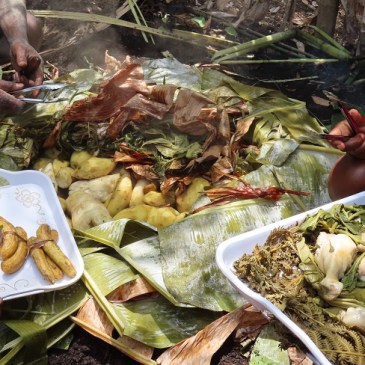
We will eat lunch here, but it is no ordinary lunch; John tells us they do this for special occasions. A pit dug in the ground is bedded with hot stones and lined with banana leaves. Ferns from the forests and leaves similar to pumpkin, both edible, are layered on top. On this are laid, chicken, lamb, sweet potatoes, cassava and bananas. More banana leaves are used to carefully cover the lot. Through a small hole on the top, water is dribbled in making steam that will cook the food. Snugly covered with yet more banana leaves, earth is shoveled over it and it’s left to cook.


In an hour or less, it is deemed ready and the earth and leaves carefully scraped off. John’s wife Miriam lifts out some of the meat and vegetables and lays them on a raised platform serving as a buffet. She has decorated the table with beautiful flowers and added platters of papayas, pineapples and passion fruit. All of it comes from our garden and our trees she tells us, except for the meat. “It is all organic” she adds with a smile.


Except for salt added to taste, no spices are used. Who knew it could taste so good?! If I do come here again and stay awhile, I might have to be rolled back to Goroka!

