Mountain Province, Philippines
Aug 28, 2026
Long haul bus rides usually begin late in the evening and drive through the night. The stack of goods they carry vary from car tires to giant packs of soft drinks, to mysterious sacks to motorbikes. And passengers and their bags and bundles. The main highways are decent tarmacked roads, dotted with pitstops and roadside eateries that stay open 24 hours. It is all surprisingly streamlined.


Dawn brings cloud-laced skies and spatters of rain on and off. I am in the mountains now where rainy season has descended with a vengeance.


Terraced fields go past the windows in a blur. The terraces climb up and down slopes and sprawl along the valleys next to frothing streams.
It reminds me of the terraced fields in the high Andes, seen many years ago in Peru. These are startingly similar!


In the heart of the mountain province the secondary roads are small all-weather concrete. They wind their way through valleys and most not even a decade old. Houses and shacks line every inch of the road it seems. I have a sense of déjà vu – this is so much like Nepal, and to a lesser extent to Bolivia. Heavy rains spell landslides and there are plenty. Some are from the typhoon a couple of weeks ago but there are more recent ones, barely a day old.


In smaller towns the transport is mostly jeepneys, vans and mostly the tricycles unique to Philippines – the ones that are like a sidecar attached to a motorbike. My dress code on this trip includes a neck brace and a knee brace. The last thing I should be doing is jolting along on these roads in contraptions that have yet to say hello to suspension systems. But needs must I tell myself.
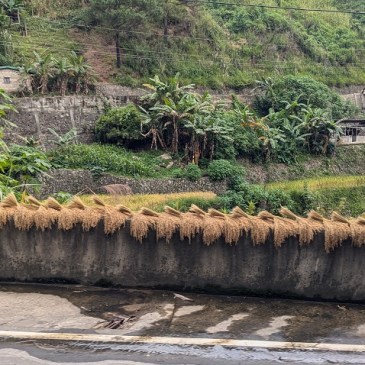
I see bunches of rice, drying by the roadside; harvest season is well on its way. Most of the rice grown here need to be harvested by hand but not with a sickle. They use a gamulang – a metal blade set crosswise on a short wooden stick. The stalks are lashed together in small bundles. They will be pounded instead of milled, another labor-intensive process.


They have a novel use of old tires here; tied together and lain across the road, they form a unique speed bump. Another novelty are the baskets strung on cables across a stream or down a slope. They are mostly used for goods.


Well, that is not quite a novel technique. Years ago, I remember crossing the Zanskar river in Ladakh, India in much the same way. At the end of a trek, my backpack and I were bundled into the hanging basket and hauled across to the other bank.

