Lake Sebu, Philippines
Sept 13, 2026
The T’boli museum or the Gong House as it is called sometimes, is not far. The outward leaning walls of the house on stilts make me smile to myself; I wonder what other links I may find. Built like one long room, it has split bamboo flooring and a narrow raised platform that runs around the perimeter. In days of yore it would house all family members but nobody lives here now.


The gentleman who collects the entry fee is happy to tell me about the items. Much like in Banaue, it is not so much a museum as a collection of assorted bits and pieces. Most prominent are the brass gongs, used by the T’boli on all religious and cultural occasions. I think of the gongs I had seen used in the longhouse in Malaysian Borneo.


There are old anklets and bangles also made of brass, a craft that the T’boli are famous for. Folklore claims the T’boli have been using the lost wax method since time immemorial, but there are no records. Historians note these brass traditions coincide with the Malay maritime networks of 17th century bringing in metals. There is an elaborate belt worn by women with small brass bells at the end of chains, the bells designed to be at the back. My mind leaps to the brass bells hanging from belts I saw the Amis wear at the Ilisin festival. Is there a connection? It is unlikely I think, given the gap in timelines but intriguing all the same.


There are combs with beaded and feathered decorations. They have long strings of beads designed to hang down on either side of the face. Again, I think of the Amis headdresses. But these were common in southeastern China and likely came here later in the long history of human migration.


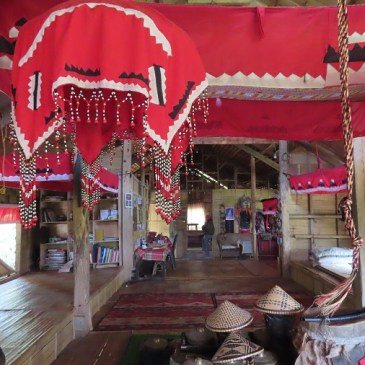
A traditional T’boli hat for women looks like an embroidered red handkerchief laid atop a shallow palm basket. A few photos on the wall show women wearing it on special occasions.


One photograph though catches my eye. The headgear of a T’boli woman gives me an instant flashback to a similar one seen at the Bunun Cultural Center in Taiwan. Is that the origin of this? I have no idea. There is something else. The word for the small dugout canoes is banka. This word and similar ones are widely used across the Austronesian family of languages for a small outrigger canoe. My smile turns into a grin. The gentleman looks inquiringly at me as we sit down to chat.


When I mention Austronesian roots of the T’boli, I am gently but firmly rebuffed. I am told that the ancestors of T’boli came from South China; there is no room for discussion. Ah, I think, here it is again: The results of Henry Otley Beyer’s theory of the origins of Philippine tribes. Based on folklore and tribal tales with no data for support, his conjecture made its way into school textbooks and now a couple or more generations later, still holds sway. But when I ask about funeral traditions, the answer makes me sit up. The T’boli (and the Blaan) used to hang their dead from the trees in wooden coffins. Not only that, the coffins were shaped like boats! Ha! I grin to myself. The loud voice of legacy is not to be denied. The practice among the T’boli though had evolved so this was practiced only for infants and toddlers. These days the dead are buried in cemeteries, this practice having died out.
There is another building here called the School of Living Tradition that is newly built in a traditional way. It is the brainchild of the grande dame of T’boli traditions, Ms. Maria Todi. She has been instrumental in generating interest and sharing T’boli traditions with visitors. She is not at home, but I am allowed to poke around and take some photos. This building is larger and the similarity to a longhouse is more fact than fancy.


A short set of steps about halfway along the length of the house leads inside. This too is one long room but here, to the left, the raised platforms along the sides are sleeping areas. Directly across from the stairs is a hearth but I have no idea if it is functional. On the other side, is a small area with a set of gongs. There are photos and the same red hats. Scattered among old sets of anklets and bangles is new beaded jewelry for sale by local artisans.


I chat with a local and learn of their belief in spirits of all inanimate objects. Not only does she confirm the tradition of hanging burials, but tells me of a tiny uninhabited island on the lake where the dead were taken. Google map shows no islands on Lake Sebu, but I find one that does. I have no idea which island it is but I wonder if there are any coffins still left hanging. Maybe that ride in a banka is yet to be.

