Banaue, Philippines
Sept 1, 2026
The rice fields and terraces are all very pretty but what are the origins of the Ifugao traditions? The questions nagged at me and small Banaue museum seemed an obvious place to begin. It is not so much a museum as a storehouse of items collected by Henry Otley Beyer and his descendants. Signage is few and far between but most interesting perhaps are the photographs from early 1900s of dress, tattoos and celebrations of the Ifugao over vanquished enemies.


There are a few objects as well; the cross-armed sitting figure that is Bulul, the rice god. Wooden chests and some spears and shields adorn one wall. More than the others, one object jumps out at me: a gong with a unique handle. It was made from the jawbone of a vanquished enemy!


All interesting but I am no closer to answers. Maybe from some of the farmers and their families? I set out to pester locals at shops and small eateries and find one young man. He says his family lives down in the valley, maybe an hour’s walk from Banaue. They are to have a ritual connected to the rice harvest that I was welcome to observe. My ears perk up and I waste no time accepting the invitation. No transport can reach their house; I will need to walk.
I set out on a narrow path hugging the contours of the mountain. Sometimes I walk on the cement border of the canal and sometimes on a dirt trail. Concrete steps go off the path heading up or steeply down to homes and fields of other families. A waterfall cascades down across the valley and I see more rice terraces. I just hope it doesn’t rain; a rain-soaked slippery path is not what I look forward to. The knee in its brace will definitely not be happy!


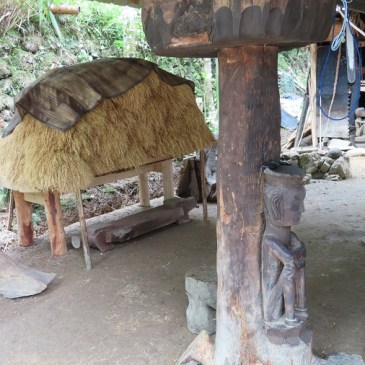
An hour later I reach their house. In the yard are a couple of buildings, one that houses the family and one that is built in the traditional style of a rice barn. It stands high off the ground on stilts. The massive legs have carved wooden statues of Bulul. Although not exactly the same, the basic structure with its stilts, the outward-leaning paneled walls and the single chamber inside are reminiscent of the houses I saw in the Karo highlands of Sumatra, Indonesia. The panels themselves are carved with scenes of ceremonies involving rice cultivation. The chicken and pig sacrifices, the rituals performed by the elders, the drinking of the rice wine and the prayers for a good harvest are all recorded in the hand-carved panels.


Along one side is a pile of rice already harvested. Next to it are skulls of animals butchered in the past. I spy a monkey skull but he tells me vociferously that they never sacrificed a monkey. Among the paraphernalia of rituals is a basket covered with shaggy palm fibers. The ceremony has no fixed time and may well take place after dark. The rain has started in earnest and I cannot wait. Reluctantly I make my walk back gingerly on the rain-slick path.


A day later I meet Juanita, a lovely older lady in town who I am told, knows all about old traditions. Lack of Tagalog on my part makes for a stuttering conversation but I learn how every milestone of life is marked by rites and rituals. For rice cultivation itself, there are a dozen or so rituals that are spread across the season. And woe betide anyone who does not follow the prescribed rules!
But none of this provides any connections between the Ifugao and their Austronesian lineage. Maybe just one curiosity that struck me. In Banaue a lot of local women wear earrings and pendants that have a singular design. It is circular, with a hollow circle that is off-center, making for a thicker lower rim. And there is a vertical slit at its bottom rim. Made in various sizes and materials, they are on sale in all the souvenir shops in town. When I ask, they tell me it is lucky. But why is it lucky and since when are questions they have no interest in.


I have seen this shape before. Of course! I saw it in the Prehistory Museum in Taitung. Those jade earrings again! The older ones had uniform rims but the later ones also thousands of years old, had morphed into ones amazingly similar to these ones, barring the protuberances. Is this too much of a stretch? Am I seeing too much into this? I have no idea but the similarity in shapes surely cannot be a coincidence! I might have to make a second visit to the museum in Manila and find someone to pester.

