Sagada, Philippines
Aug 26, 2026
Some Austronesian migrants settled in the Batanes islands and their descendants still call it home, but others had itchy feet which led them to sail onto northern Luzon in the Penablanca area of the Philippines. Over the eons they moved into the Cordillera and are collectively called the Igorots. The isolation of the landlocked mountain provinces and stiff resistance to colonization have been key in preserving their genetic lineages. A recent paper makes fascinating reading about not only the Cordillerians, butother lineages of Philippine population. Genetic studies show that among the Cordillerians, the tribes with the strongest ancestral markers linking them to the Austronesian mariners are the Kankanaey, Ifugao, Bontoc and Kalanguya.
My intent to visit each tribe and learn about traditional practices and beliefs that exist to this day, and maybe share a common heritage begins with Sagada. Promises to myself to avoid long overnight bus journeys fall by the wayside as I get on a bus from Manila bound for Sagada, the ancestral homeland of the Kankanaey. Twelve hours later, groggy from lack of sleep I reach the tiny village. Perched at 1500 m, it is set in a verdant valley and was known for its abundant fruits and vegetables.
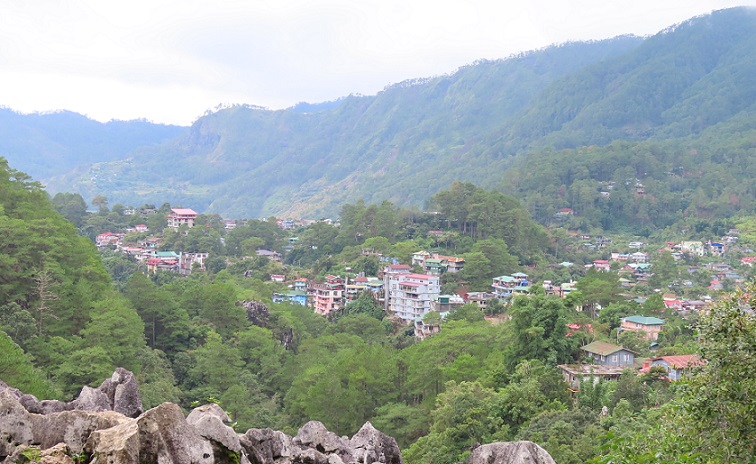
It was idyllic as recently as ten years ago. The advent of a sealed tarmac road has led to a deluge of tourists. Today the single road that runs through the village is lined by houses, every second one a hotel or guesthouse. If not a guesthouse, then a souvenir shop, each selling identical kitsch. If not a souvenir shop, then a restaurant or cafe. Word is, the abundant fresh produce is in short supply since the fields lie fallow, the farmers preferring to earn more from tourism. There are a few old houses left but the race is on to construct modern ones to accommodate yet more tourists. A cookie-cutter Disneyland looms on the horizon. This is inevitable I suppose, and sadly, a reality not only here but in many parts of the world.


Sagada’s claim to fame is its hanging coffins. I had seen this practice in Sulawesi, Indonesia many years ago; surely they must share a common origin for a practice as unique as this? Among the Tana Toraja in Sulawesi, by some accounts it was said to have begun as recently as the 8th century and by others even 16th century CE. In Sagada though, according to some anthropologists, these cliff burials have been practiced for two millennia. Some anthropologists believe this is a shared tradition retained from cultural practices originating from Austronesian roots transferred via maritime migrations.
The later date in Sulawesi would indicate the practice traveled to Sulawesi from here. Lacking any vetted documentation, I can only make guesses but questions bubble up in my mind. The coffins in Sulawesi were shaped like boats. I remember a conversation in Sumatra, Indonesia where the roofs of houses were boat-shaped because according to the locals their people came by sea. Can it be that it was from Philippines that they traveled and settled Indonesia, hence the common trait?
I have no answers but seeing the coffins is very much on the menu. Accompanied by the requisite guide I set off. At the edge of the village, a paved concrete path leads down to a valley lined with limestone cliffs.


It is riddled with nooks and crannies and the dead were placed in wooden coffins, usually in fetal positions in holes in the cliff. The higher the coffin, the closer to the heavens, was the reason. From afar, through gaps between trees I spy them.


As we get down closer, I see them clearly. They are placed on metal beams drilled into the rockface. There is one old, smaller coffin with the deceased in a fetal position but most are newer, longer ones where they are placed in a supine position. My guide Ben tells me that this practice came with the advent of Christianity. Indeed, some coffins have a cross either painted on or slung over it. There are others too, Ben tells me, all over the cliff-face. I see one tucked into a niche to the side. Closer to the ground is the lid of a coffin with a carved lizard on it. Ben tells me lizards are lucky.
Oh! I remember seeing lizards carved on houses and gables in Sumatra, Indonesia and being told lizards are considered lucky. Here too is the same belief! Is this yet another indication of shared roots? The thought fascinates me.


Although the locals adopted Christianity, Ben tells me they still practice their older animist traditions to this day. Birth, baptisms, weddings and funerals all involve dual practices of both beliefs. In talking to some locals I learn that important events such as planting crops and harvesting require a ceremony led by a ritual master and the sacrifice of a chicken or a pig. I think back to when I saw such a ceremony in Cambodia, deep in the forest. I also remember seeing the cleansing ritual officiated by shamans in Mentawai, Indonesia. It is common in every indigenous culture to propitiate the gods and spirits but fascinating nonetheless to see such similarities across huge geographical distances. We walk back to town, my mind whirling with questions.
In talking to some locals I ask about customs and rituals. I feel extremely privileged to be shown some old photographs of ceremonial rites. I see people dressed traditionally for such ceremonies, if not everyday. But looking at the photos I also see a gradual trend towards modern everyday clothing slowly eclipsing the older tradition.


I wonder if the other tribes still retain any of their culture. I hope to find out soon.


I remember a friend going to the Philippines a while back and posting about these hanging coffins. Such a unique custom, and while a bit morbid I am sure it’s interesting to see!
LikeLiked by 1 person
Well, it makes sense if you think the families of the deceased would want the coffins safe from scavenging animals – at least in the old days. And once it becomes a custom, it carries one I dare say.
LikeLiked by 1 person
I was about to say that the hanging coffins of the Kankanaey reminded me of what I saw in Tana Toraja. Then you mentioned that you’ve also been to the latter. It’s always fascinating to find these traces of possible past connections between communities across Maritime Southeast Asia, isn’t it? You also made a good observation about the lizards as it is indeed ubiquitous in Batak carvings in the highlands of North Sumatra.
LikeLiked by 1 person
So you note the similarities too? Fantastic! I absolutely love it when I see these similarities and then to figure out the connection makes me do a hop and a skip. Epiphanic instances also happen when I find linguistic connections – then it’s a jig!
LikeLiked by 1 person